
Why offline transcription changes the privacy equation
Your voice is uniquely personal. Keeping recognition on-device removes the upload, the waiting, and an entire category of privacy risk.
Audio deserves a higher standard
A recording can contain names, health details, work discussions, and the sound of a room. Unlike a password, your voice cannot simply be reset. That makes the route an audio file takes just as important as the transcript it produces.
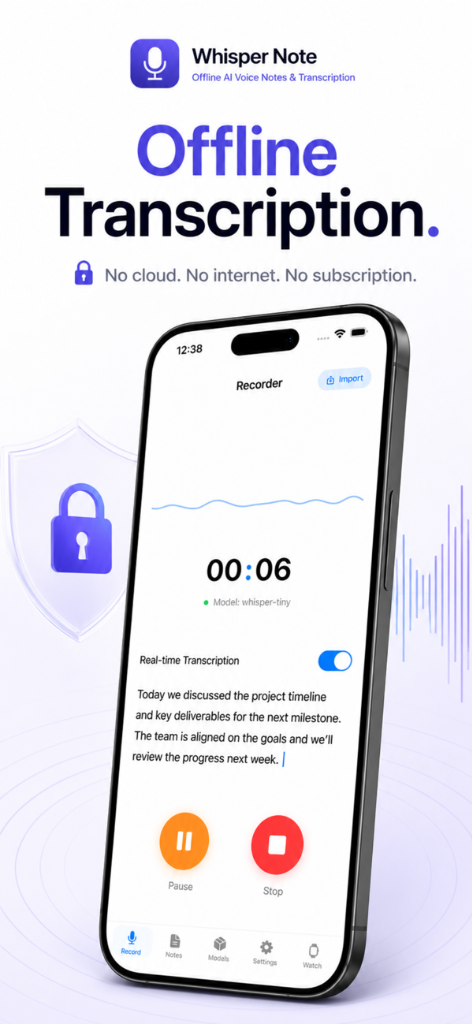
Offline transcription shortens that route to almost nothing: audio is selected or recorded, processed locally, and saved as text on the same device.
Private also means dependable
Local processing keeps working in a flight, a basement, or a crowded venue with unreliable Wi-Fi. There is no upload queue and no server outage between you and your notes.
The practical benefit is simple: record when the thought happens, transcribe when you are ready, and keep control of the original file.